Still Waters Reflection No. 1 - Awareness - Where it Begins - Foundations of Whole Person Wellness
Before we can intentionally respond to what we are experiencing, we first have to notice it.
Awareness is one of the strongest foundations we can cultivate because it opens the door to intention, presence, and mindfulness. From awareness, we can begin exploring our breath, patterns of stress and regulation, movement, rest, habits, interoception, and the many dimensions of whole-person wellness.
But awareness does not require us to immediately change anything.
Sometimes, it simply asks us to notice.
What Does It Mean to Be Aware?
Awareness is not necessarily analysis. It is not immediately searching for what is wrong or deciding what needs to be fixed.
It can begin with a simple question:
What am I experiencing right now?
Perhaps you notice the rhythm of your breath.
The feeling of your feet against the floor.
Tension in your shoulders or jaw.
A thought that keeps returning.
An emotion quietly present beneath the busyness of the day.
Or perhaps you simply notice that you are tired.
Awareness gives us an opportunity to observe what is already present—sometimes before we even know what, if anything, we want to do about it.
Why Do We Sometimes Miss What Is Already There?
Many of us have become very practiced at being busy.
Our days can be filled with responsibilities, phones, notifications, conversations, caregiving, work, and the seemingly endless list of what needs to happen next.
Over time, moving quickly from one thing to another can become habitual. We operate on autopilot without necessarily realizing that we are doing so.
Meanwhile, quieter signals may go unnoticed.
The breath may become subtly restricted.
The shoulders may gradually rise toward the ears.
Fatigue may accumulate.
Thoughts may begin moving faster.
We may feel increasingly overwhelmed without recognizing the smaller signals that appeared along the way.
Awareness invites us out of autopilot for a moment.
Not necessarily to change what we find.
Simply to notice.
Awareness Without Judgment
This part matters.
Awareness can easily turn into judgment if we are not careful.
We notice tension in our shoulders and think:
My posture is terrible.
We notice our breath feels shallow and immediately decide:
I'm breathing wrong.
We notice that we feel distracted during meditation and conclude:
I'm bad at this.
But awareness does not require a verdict.
Instead, we might practice responding with curiosity:
Interesting. This is what I notice.
My shoulders feel tense.
My breath feels different today.
My thoughts are moving quickly.
I feel more tired than I realized.
There is something powerful about allowing an observation to simply be an observation.
When we notice without immediately labeling an experience as good or bad, right or wrong, we create space to become curious about what we are experiencing.
And curiosity can help inform what comes next.
Krama: One Step at a Time
Yoga offers us a helpful concept called krama.
Krama can be understood as a step, sequence, or gradual progression. When applied to an awareness practice—or to many yogic practices—it reminds us that we can approach something progressively, one intentional step at a time.
Meaningful change often unfolds this way.
Not all at once.
Not through forcing.
But gradually.
Awareness may be an early step in that progression because noticing gives us information.
And with information comes the opportunity for choice.
From Awareness to Choice
A simple progression might look like this:
Pause → Notice → Become Curious → Choose → Respond
We pause long enough to interrupt autopilot.
We notice what is present.
We become curious rather than immediately judging.
Then, when appropriate, we choose how—or whether—we want to respond.
Sometimes the response might be movement.
Sometimes it might be noticing or gently shifting the breath.
Sometimes we may realize we need rest.
Sometimes the most appropriate response is simply to continue observing without changing anything yet.
And sometimes awareness helps us recognize that we may benefit from support from an appropriate healthcare or wellness professional.
Awareness does not always tell us exactly what to do.
It simply gives us a place from which to begin.
Maybe Give Awareness a Try
We do not need to make awareness complicated.
In fact, I believe simplicity becomes sustainable.
A meaningful practice does not always require thirty minutes, a yoga mat, special equipment, or a perfectly quiet room.
Sometimes it begins with one minute.
A Gentle Practice: The One-Minute Arrival
Wherever you are, allow yourself to become comfortable.
Notice the places where your body makes contact with what is supporting you—the floor beneath your feet, the chair beneath you, or another surface supporting your body.
Notice your breath.
There is no need to deepen it, slow it down, or change it.
Simply notice one inhale.
Then one exhale.
Notice any sensations that naturally draw your attention.
And gently ask yourself:
What do I notice right now?
There is no need to solve anything.
No need to decide whether what you notice is good or bad.
For this moment, simply notice.
A Moment for Reflection
After trying the practice, you might consider:
What have I noticed lately that I may have been overlooking?
Can I notice an experience without immediately labeling it good or bad?
What might change if I became curious before trying to change what I notice?
There are no right answers.
The invitation is simply to become curious.
Because before we can intentionally respond to what we are experiencing, we first have to notice it.
And sometimes, one moment of awareness is enough to begin.
Rest. Restore. Reconnect.
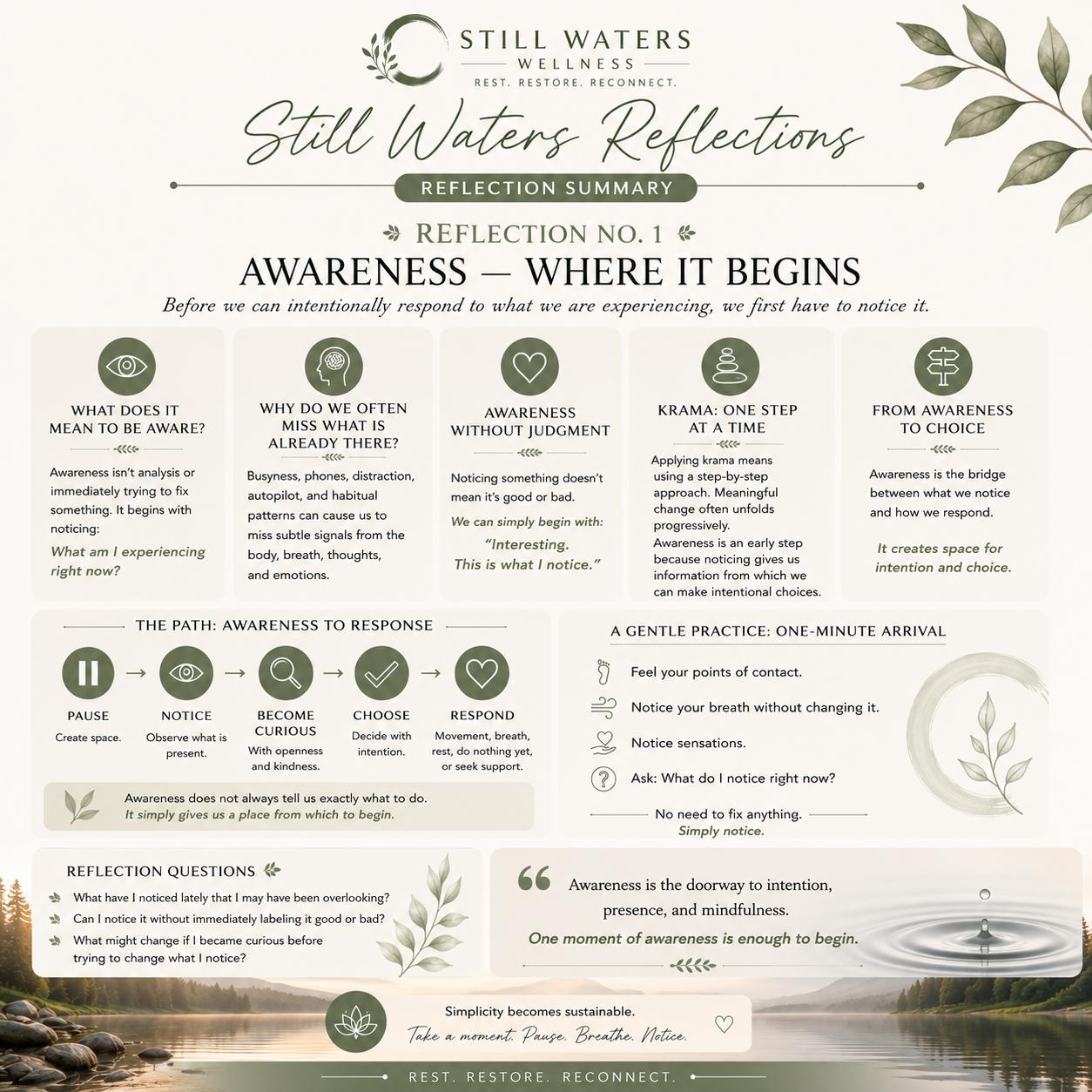
In Summary
Short on time, or want something to return to? Here are the key ideas from this Reflection.